

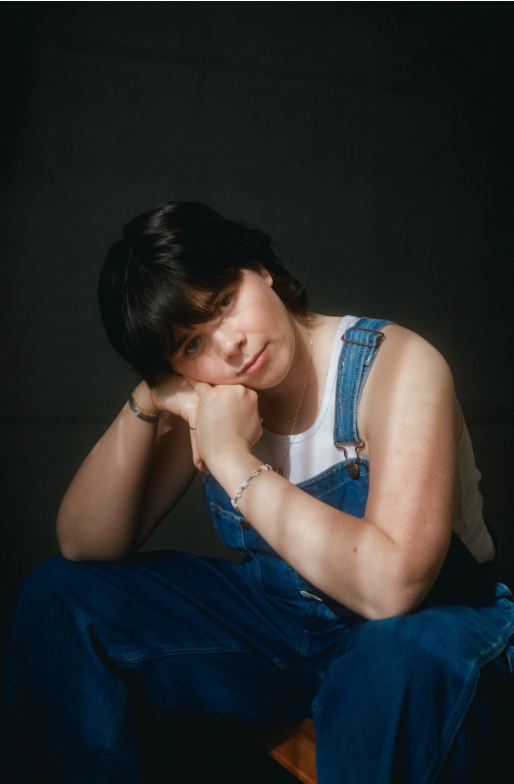
Canadian singer-songwriter Leith Ross weaves poignant lyricism with warm instrumentals, charming any listener that stumbles upon their discography. Initially rising into the spotlight by sharing their original music on social media, Leith has since released two albums & toured extensively, continuing to hone their craft.
I Can See The Future is Leith’s sophomore album, and dives into themes of grief, love, and self reflection. Across the 13 tracks, Leith explores a range of emotions, allowing each to have its time in the sun. It’s a deeply human record, relishing in the highs and lows of the human experience. They end on a note of radical optimism, declaring “and now everything grows” on the title (and closing) track.
Following the release of the album, I sat down with Leith Ross to talk about the record & this current era of their artistry.
Brigid Young: Congratulations on the release of your album, I Can See The Future! How have you been feeling about the response and reception so far?
Leith Ross: Good, it’s obviously always a bit complicated because it’s such a vulnerable thing. I keep comparing it to your birthday, like how everybody cries on their birthday because they just can’t help it. You build up your birthday and then no matter what happens, it’s never going to be exactly what you want it to be. There’s always a little bit of that feeling, releasing music. I have a really hard time with it, to be honest with you. On release days I have to turn my phone off and go touch grass. But yeah, it’s getting easier. I feel like at the week mark, I’m starting to relax a bit, and just let everything be what it’s going to be.
BY: Do you find it difficult to release work that has been yours, and then suddenly it’s shared with the world? Something about the birthday metaphor made me think about that, like being at the mercy of others & their opinions.
LR: Definitely. I usually don’t feel a preciousness about my songs. I’m usually like, yay! I’m almost glad to release them from them only being things I’m hearing. For me, it’s more like a vulnerability hangover. It’s intensely personal stuff, and then it’s just public knowledge. I don’t even think I’m totally conscious of the ways that affects me. It is definitely a strange experience. All these people, even people in my life, are knowing things about me that I haven’t told them face to face, because I’ve released music. It’s just kind of funny, it’s just out there.
BY: When it comes to the album, I Can See The Future is both the title of the album and the title track, I was curious how you landed on that as the title and also how you feel that phrase encompasses the themes across the record?
LR: I think the main thing that was pushing me to call it that was that I think “I Can See The Future” is my favorite song on the record. So that was the first inclination, and then I really thought about it conceptually and it did start to make a lot of sense to me as the beating heart of the entire thing. The reason for that is that the sentence “I can see the future” has two meanings for me that I think are both reflected in the record. One being an actual external feeling of radical optimism, and actually thinking about what the future of the world will be like even past my lifetime. Beyond me and outside of me. That is definitely something I talk about a lot on the record, these big concepts of community and the future, and all that stuff that does exist outside of me.
Then the other meaning is one that’s very personal, that comes from a lot of self reflection. I feel like a lot of the record is about me and the things that I’ve observed about myself, and my feeling is that when you reach a deep sense of understanding of yourself, you can kind of analyse the ways you’ve behaved and the relationships in your life through that lens and guess what they will look like, or how you would react in future situations. It’s kind of this combination of the personal and the external, but both coming from this analysis of what it is now. So like, who am I now? What does that mean for who I’ll be in the future? And what is the world like now, and what does that mean for what the world will be like in the future?
BY: That’s such an interesting idea, being so in tune with yourself and recognizing your own patterns in a way that you can predict how you’ll react in future situations. I wanted to ask you about the choice to have two versions of “Grieving” on the album, could you share a bit about that?
LR: Essentially it came about naturally, we couldn’t decide which version would be better suited to the song. So we recorded both. In the end, we couldn’t let go of one of them, and they both ended up on the record. But now, in a universe-y way, I’m like, it was always supposed to happen that way. I wrote it about grieving my grandfather, and about a couple of other things. But when I specifically think about my grandpa, I think about his funeral, which was obviously an incredibly difficult day, we bawled our eyes out and told stories. It was so hard and it was my first experience with really intense grief. He was Scottish and the whole family came over, and it was also the best party I’ve ever been to in my entire life. We were all drunk. We were singing until like 4 AM, having the best time in the world. I think the dichotomy of those two feelings is encapsulated in this song.
The song being about knowing that you’ll lose things, so that you really appreciate them. There’s so much preemptive grief in that, and there’s also so much joy because ideally, if you can manage it, then whatever you’re experiencing, you’re experiencing it to its fullest extent and in the present moment. So I feel like instead of trying to fit both of those emotions into one version of a song, there’s this joyous, upbeat version that lets you experience the happiness that comes along with grieving, the silver linings. And then a version where you can sink into the sad side of it. I mostly ended up really wanting them both to be on there because I thought it was therapeutic and that both of those feelings deserve to have their own spotlight.
BY: The music video is incredible also, I love the idea of a living wake. I would love to hear how that came together, like did your friends actually write the eulogies?
LR: Yes, we did a real ceremony, which is so awesome. The geniuses we worked with, FOLKS FILMS here in Winnipeg, we did the actual living wake for all five of us, and they filmed it. Then we filmed some other things to fill it in, most of the audience being there and stuff, so it did kind of seamlessly look like one event. But in reality, there was actually about a 45 minute long living wake where we all gave eulogies for each other, each of us gave a eulogy for another person. It was so awesome, we cried so much, but it was in such a happy way. I sincerely would recommend it to anyone. It was such an amazing, amazing day. Definitely existed outside of the music video and then everything else was just a bonus.
The reason why I chose that concept is because that’s one of the things I wrote the song about, is the fact that my mom has, for the longest time, been insisting that we give her one when she gets a bit older. She always found it so silly and annoying that people say the nicest shit they’ve ever said about you in their lives after you can’t hear it. She’s like, I want to know all the nice stuff people are going to say about me. I don’t want to be gone for that. Like, why am I the only person who doesn’t get to hear how much you all love me? So yeah, that’s kind of what it was born out of. It was just the best.
BY: I love that it was a real event that just happened to be filmed. I knew those emotions in the video had to have been genuine. A standout song on the record for me was “Home,” specifically the repeated last line “I will find home.” What is your definition of home?
LR: Good question. The definition, I don’t know that I can give it to you, which is partially what the song is about. I think I wrote that song just over a year ago, maybe less. I wish I could say that my feelings or my life has changed since then, but they really have not. And I’m still searching for what it is. I often thing, oh, it’s just the people. As long as I’m around the people I love, I’ll always feel at home. Then I have moments where I’m like, maybe that’s not true. There has to be something else. There has to be some intangible thing. Sometimes I go back and forth on that. I feel kind of torn between all these places and people in my life, and I don’t really know where home is. I have brief flickerings of it, sometimes it’s there when I go back to my parents’ house where I grew up. Sometimes it’s here in Winnipeg, in little moments. But I don’t feel there is one center that makes me feel really at home, and I guess my next question in my life going forward is: does that exist? Or do I have to try and make it exist, and be okay with having it in a bunch of different places or people, and never having it in one?
BY: As of right now, when do you feel most at home?
LR: I would say when my friends are over, or when I can see my family. A few nights ago my friends threw me a surprise party for the record, and everybody was over, we had some whiskey, and moments like that where I’m like, okay, this feels like home.
BY: The most intriguing song to me on this album, by far, is “I Love Watching You Eat Dinner.” It expresses love in such an interesting way. Could you share a bit about that track?
LR: I love that song. I think it’s one of my favorites on the record. This is my favorite thing to use to describe it in my head: the song is happening in a 15 second window in slow motion. The scene is that you’ve cooked your friend dinner and they’re over at your house, you put it down in front of them. Sometime in that dinner, there’s a 15 second window where you’re watching them and everything is in slow motion. It’s sort of glowy. They’re picking out a bite on their plate, eating it and swallowing it and taking a sip of their drink. You’re looking at them and it’s this slow motion, beautiful moment that makes you want to cry. It’s supposed to make you think of the greater or deeper meaning of feeding someone.
Making someone dinner, it feels like such an obvious thing. But we’re so disconnected from food in many, many ways. Politically, personally, in every way, we’re kind of disconnected from food and our food sources. I also think we’re disconnected from how essential it is to feed each other, and how much more essential it might get. I think it’s kind of a radical thing, to give someone a meal, because we need it to live. It’s not just thinking about the fact that you love them and you’re giving them dinner, but it’s also thinking about this greater thing: we’re both people, we’re both human beings, and we’re participating in this incredibly ancient, beautiful tradition of feeding each other. And then also, what does that mean, in another metaphor, for how we live in the world. As a human being and a community member, even with people I don’t know, I would like to feed them. Emotionally, you know, literally, give somebody dinner who wasn’t going to have dinner. It’s a snapshot of a moment where all of a sudden, you’re thinking about what it has always meant and will always mean. What is the larger and more human, and intrinsic meaning of this tiny moment that seems normal?
BY: I love the idea of feeding someone as a radical act of love or care, yeah. This is your sophomore album, how did the creative process differ from To Learn?
LR: There were some logistical things. To Learn I made in Winnipeg with Joey Landreth. At the time I was living a 30 second walk from the studio we were working out of. It was a couple days a week for a year, or sometimes there’d be a break, but it was like a roll out of bed, like, hey, you want to work today? And then one of us would say yes or no, and we’d meet there. It was very chill, casual and constant, we didn’t really have to go out of our way if we didn’t want to. Then because we made this record in LA, I would go for two or three weeks and we’d do a lot of work every day for two or three weeks. It was very intensive because I wasn’t living there, so we couldn’t do it casually. Apart from that, a lot of the processes were the same, just as far as how we worked together. In both situations it was very spontaneous. We’d decide what song we wanted to work on when we got in, and then it was just bouncing ideas off of each other, and trying things, and going back and forth. It was quite eclectic, and it was fun, and really creative. There was not too much planning involved. I never really have been good at making records that way, and maybe one day I’ll make some cool concept record where everything is meticulous and planned out, like I have a real vision. But mostly I’m like, okay, I think I like these 10-13 songs from this last year of my life. Let’s record them in a random order.
BY: You mentioned being based in Winnipeg, what is it like being a creative there? How does your environment impact your work?
LR: I love it here. Most importantly, there’s an amazing music scene. But second most important, it’s not an industry hub for music. If you were doing anything in the music industry in a big way, you’re going to Toronto or Vancouver or somewhere in the States. Because there isn’t a lot of industry representation here, there is much less of a competitive atmosphere, that just happens in big cities. I think sometimes it’s good, sometimes it’s inspiring. But I didn’t like it. In Winnipeg, there’s no like, ‘oh, an A&R is coming to the show’ or ‘oh, this person knows this person who’s coming to the show,’ there’s basically none of that. There’s a real community based music scene where everyone is incredibly supportive of each other and it doesn’t feel like you’re all competing for the same couple of slots. It feels like there’s lots of room. Also it’s affordable, which is a huge thing for any artist that is kind of undervalued. Most people can work a part time job and at the very least be able to afford rent, which is a massive advantage because it gives you time to be creative. I like it because when I come back here, I’m retreating a bit from the world and the music industry, and my life doesn’t revolve around that. It’s like a little oasis.
BY: Do you feel that being disconnected from the industry, in that way of not being in a big city, allows you to be more connected to your work?
LR: Definitely. I feel like anything that takes the ego out of it is good. I fight so hard against the insecurities and the ego and stuff, especially in this day and age where you can see numbers on everything. It’s six million bajillion things to be insecure about, and if those things are all removed, as even a possibility, I just sleep well at night, for the most part.
BY: You’re hitting the road in a few weeks, what are you most looking forward to about being on tour?
LR: I would say contextualizing the human beings behind the people who listen to my music. I sometimes feel like there is no context for the relationship between all of us, and I often feel quite disconnected from my job in that way. Tour is hard for me for a lot of reasons, but the thing that I always find solace in is sharing a room with a bunch of people who have at least one similar interest, or similar thoughts to me. A community. It helps me feel like I’m a part of something instead of just removed from it. That’s always the most important emotional element.
BY: To wrap up, which track from this record are you most looking forward to playing at your live shows?
LR: The answer I have mostly been giving is “Alone.” I think the end will be some good therapeutic yelling opportunities for everyone involved. I think it’s the most fun song to sing. It’s definitely the one that challenges me the most vocally, and I like to stretch that muscle every once in a while. For vibes, “(I Can See) The Future.” That would probably make me feel good and weepy and better about the state of the world.
Listen to I Can See The Future here!